.
Kansas City Star - Community Supported Agriculture (CSA)
Cornucopias amid the concrete
As demand for fresh food grows, more people are tilling big yards and empty lots.
By VICTORIA SIZEMORE LONGThe Kansas City Star
These budding businesses — found near the paved parking lots of downtown Kansas City, in inner-city neighborhoods in Kansas City, Kan., and in the back yards of suburban Raytown — are easily identifiable by the bounty springing from the earth.
They are urban farms. And their numbers are growing — in Kansas City and other U.S. cities — right along with consumer interest in fresh locally grown food.
“There is a big demand, and people are stepping in to meet that demand in various ways,” said Ted Carey, vegetable specialist for Kansas State University Research and Extension.
He refers to people like John Kaiahua, 64, who owns and operates JJFarms in Raytown, providing fresh produce to regular customers through subscriptions.
“I liked growing so much, I wanted to take it further,” Kaiahua explains.
Although businesses like JJ Farms may be small, often providing their owners only supplemental incomes, they seem to be here to stay.
“In the last 10 years we have seen a real spurt of growth,” said Katherine Kelly, who, with Daniel Dermitzel, founded the Kansas City Center for Urban Agriculture in Kansas City, Kan. And the trend has picked up in the last few years, Kelly said.
Passionate farmers eager to nurture other urban growers, Kelly and Dermitzel created the center in 2004 to promote community-based small-scale entrepreneurial farming in the area. They have a vision of city farming that includes:
•Small community-based farms scattered throughout the area, providing fresh and healthy food to city residents.
•New opportunities for people who would like to farm and generate an income doing so.
•Urban design that turns unused, vacant and unsightly spaces to productive use and treats small-scale agriculture as an integral part of a beautiful, lively and healthy neighborhood.
That vision seems to be taking shape.
Farming returns
Although the Kansas City area was once devoted to large-scale farming, most larger farms today are outside the Interstate 435 loop. One of the few remaining — a 40-acre spread in Lenexa owned and worked by Earl Hoehn and three other family members — is for sale.
But urban farmers are finding a way to bring farming back to the city.
About 35 urban farmers are growing in their neighborhoods and selling on-site or at farmers markets in the area, Kelly estimated. There is no real way to know the actual number, because many are low-key and operate under the radar.
“Urban farmers are pretty diverse,” Kelly said.
Most urban farms are worked on once-vacant lots by individuals who have either purchased the land or are borrowing the tracts from nearby businesses. Sometimes they sprout along major inner-city thoroughfares.
Some urban farms, like Kaiahua’s JJ Farms, started out as simple backyard gardens.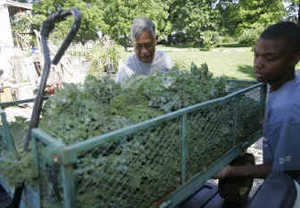
Some are worked by community groups or individuals who are looking to turn blight into might. Some are operated by immigrants who came to America with farming and agriculture backgrounds and wanted to continue that. Some are worked by retirees who have found a second calling.
But they all are folks who want to connect with their communities and build relationships.
For some, urban farming takes them back to their roots, and that’s one of the things that make Kansas City unique in urban farming, Kelly said.
Many of today’s urban farmers are just a generation or two removed from families that farmed full-time and whose lives revolved around agriculture.
Take former Kansas City, Kan., Mayor Joseph Steineger. At one time, Steineger’s family had a large farming operation with thousands of acres in Kansas City, Kan. Steineger helped work that land growing up.
And now, in retirement, Steineger has returned to the land. On about 1½ acres in Kansas City, Kan., Steineger grows tomatoes, peppers, cabbage, lettuce and more, and sells at the Kansas CityKansas Green Market at Sixth Street and Tauromee Avenue. He also raises wheat, corn and soybeans on about 600 acres scattered throughout Kansas City, Kan.
Kelly said she once went for a drive with Steineger, who took her through the area where his family once farmed. Today most of it is paved over and has become an industrial area.
“I got a sense of what it once must have been like and what it could be today,” Kelly said.
By the moon
Compared with some urban farmers, Kaiahua is rather unusual in his depth of experience. A master gardener, Kaiahua took up urban farming shortly after retiring in 1985 after a career with the Marine Corps.
His JJ Farms can be found in the midst of a middle-class neighborhood just off of Blue Ridge Boulevard on East 81st Terrace — row upon row of broccoli, chard, Chinese cabbage, Napa cabbage, carrots, cucumbers, Chinese eggplant, green beans, kale, lettuce, peas, peppers, potatoes, squash, tomatoes and zucchini.
“I grow just about everything from A to Z,” said Kaiahua, who is an organic grower.
His wife and co-owner, Judy Kaiahua, keeps the books.
Kaiahua grows all his produce in three large back yards that encompass 1½ acres there on his block. He wastes no land.
While most urban farmers sell their goods at farmers markets and other venues, Kaiahua sells directly to people through what’s known as Community Supported Agriculture, or produce subscriptions.
CSA is a partnership between consumers and farmers. Members normally join a CSA at the beginning of the calendar year, reserving a spot and paying for at least part of the season up front. This helps to provide a guaranteed market and income to the farmer.
Kaiahua used to sell his produce at farmers markets as well as to local restaurants and grocers. But because of the limited growing space and due to the time, effort and mass quantities it takes to supply so many venues, he decided to focus on a niche market of subscription customers.
He has 30 to 40 such customers and delivers produce within a day of harvest at various drop sites in the area.
A family membership runs about $450 per season. A couple’s membership is about $375, and an individual membership is $300.
Growing interest
Kelly and others say the growing demand for local food that is drawing in urban farmers as part of the food supply chain stems from several factors.
For one thing, recent food-safety problems have made people much more conscious about what they eat. They want to know where their food is coming from, and they want to meet the people who grow it, Kelly said.
This consumer awareness has spawned several “movements” across the country.
The 100 Mile Diet, for example. This is a back-to-basics approach to find, eat and enjoy food from farms, orchards and other producers within 100 miles of their homes.
Best-selling author Barbara Kingsolver’s latest book, Animal, Vegetable, Miracle: A Year of Food Life, details a year that her family ate only locally produced food, much of which they grew or raised themselves on a farm in southwestern Virginia.
As Kansas City area CSA customer Don Reck puts it: “It makes no sense to live in the breadbasket of the world and be at the end of a 1,500-mile supply line to California or even South America.”
Growing support
For the urban farmers, support comes from other directions as well.
The Kansas City Center for Urban Agriculture develops training and research programs for new and experienced farmers and for city planners and community members interested in city farming.
Center founders Kelly and Dermitzel also operate the Kansas City Community Farm, a 2-acre certified organic urban farm in the Argentine neighborhood of Kansas City, Kan. The farm is an educational and research site for urban farmers and others interested in urban agriculture.
The Growing Growers Training Program is another local effort. Kaiahua participates in the program, which trains farmers in local food production, partly through on-farm apprenticeships. The goal is to increase the number and effectiveness of small farms that grow food organically and sustainably for the Kansas City area.
The program is a collaborative effort of University of Missouri Extension, K-State Research and Extension, the Kansas Rural Center and the Kansas City Food Circle.
Kaiahua’s apprentice is a 17-year-old who is part of the Troostwood Youth Garden at 51st Street and the Paseo in Kansas City.
Kaiahua is frank about the nature of his work. It is time- and labor-intensive, and it might not pay off as well as some would hope.
It pays to start small, learn as you go and build up if you think you can handle it.
“Every year I know what I need for my customers,” he said. “I know how many customers I have and what they need, and then I know what to grow.”
Because he doesn’t have a lot of overhead and because he cuts costs by using compost for fertilizer and plants in raised beds to help better retain moisture, Kaiahua said he often could keep his seasonal expenses at about $2,000.
And depending on the growing season and customer demand, he can pull in anywhere from $8,000 to $15,000 from produce sales.
Kaiahua, who gets a monthly pension from the government, and whose wife works, cautions that most urban farmers cannot make a living from it.
But for Kaiahua, turning to urban farming was a natural.
He loves growing things. He’s helping meet a demand for fresh, local produce. And he’s helping support the local economy, something that is very important to him.
“Why buy from California when it’s right around the corner?” Kaiahua said. “We keep the money in the local economy, and our customers are eating in season.”
•Kansas City Center for Urban Agriculture: www.kccua.org
•Growing Growers Program: www.growinggrowers.org
•The Kansas City Food Circle: www.kcfoodcircle.org
•The 100 Mile Diet: www.100milediet.org
•The 100 Mile Diet in Kansas City: www.kcfoodcircle.org/100-Mile/
To reach Victoria Sizemore Long, call 816-234-4374 or send e-mail to [email protected]
© 2007 Kansas City Star and wire service sources. All Rights Reserved. http://www.kansascity.com